America at a Crossroads
For generations, the United States stood as a symbol of democracy, global leadership, constitutional order, and economic dominance. It was viewed by many around the world as the model of freedom, justice, and opportunity. Yet in recent years, growing political division, economic instability, accusations of corruption, attacks on democratic institutions, and controversial foreign policy decisions have caused many Americans to question whether the nation is entering a period of historic decline.
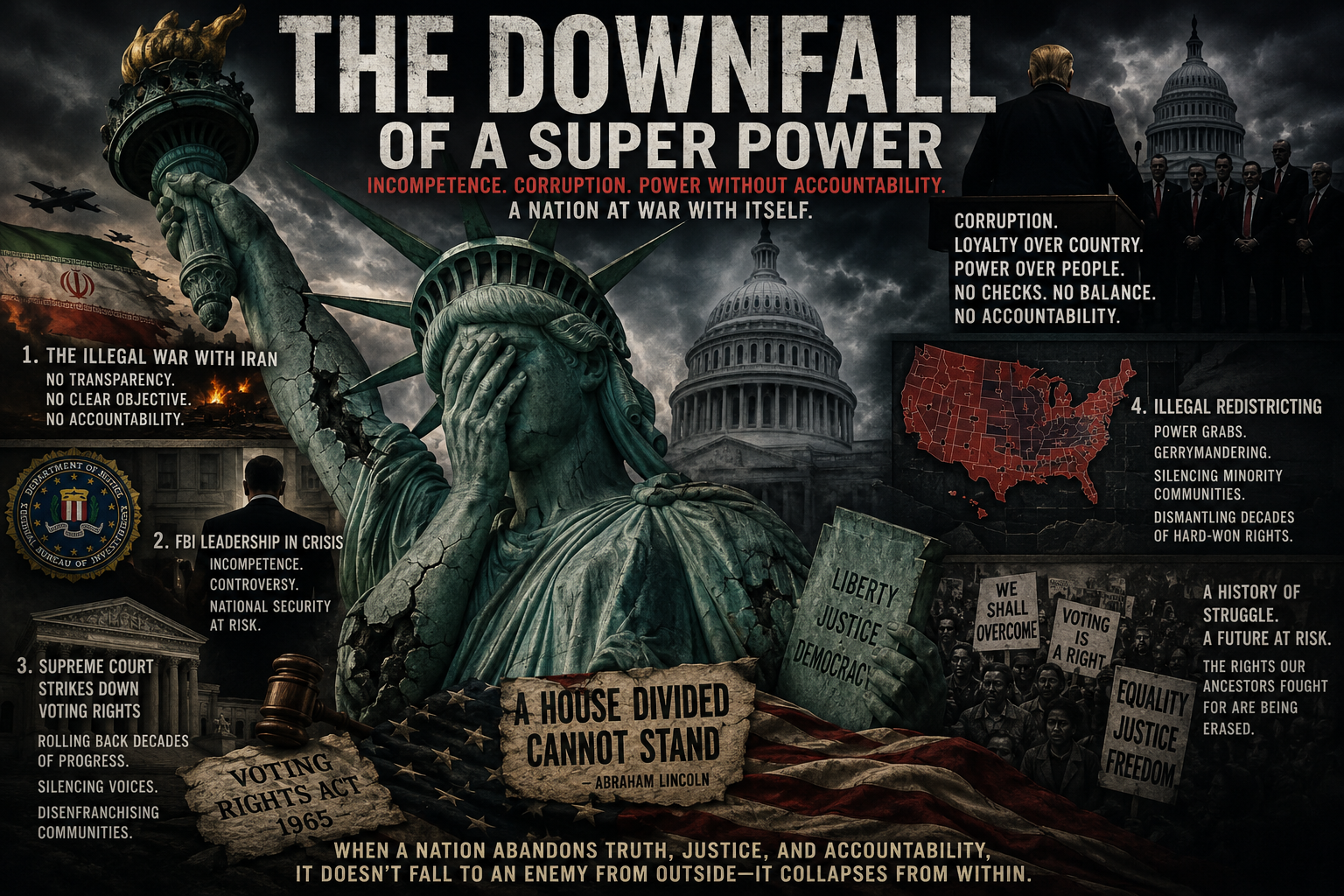
The title The Downfall of a Super Power reflects a growing fear shared across political and social lines: that the internal fractures of the United States may be more dangerous than any foreign enemy. A superpower does not collapse overnight. History shows that powerful nations often weaken gradually through political extremism, institutional decay, economic inequality, corruption, and failures of leadership. Critics argue that many of those warning signs are now visible in America.
One of the most controversial issues fueling public concern is the handling of escalating tensions and military conflict involving Iran. Critics of the administration argue that the path toward confrontation lacked transparency, clear objectives, and congressional accountability. Many Americans fear that military actions taken without broad public support or clearly defined goals could drag the country into another prolonged conflict in the Middle East — one with devastating economic and human consequences.
Opponents of the administration claim that Iran has repeatedly outmaneuvered U.S. leadership diplomatically and strategically, exposing weaknesses in American foreign policy. The perception that the United States can be manipulated or provoked into costly military entanglements damages the image of strength that once defined American leadership abroad. In the eyes of critics, confusion, inconsistent messaging, and the absence of a unified national strategy have weakened both domestic confidence and international credibility.
At the same time, concerns surrounding national security leadership have intensified. Critics have pointed to controversies involving senior law enforcement and intelligence officials, including debates over the competence, impartiality, and political independence of key figures within federal agencies such as the FBI. In a nation built on trust in institutions, any perception that national security agencies are being politicized or mismanaged creates fear and uncertainty among the public. When confidence in institutions erodes, national unity often follows.
Another major source of controversy has been the role of the Supreme Court in reshaping voting rights protections. Civil rights advocates argue that several court decisions over the last decade weakened protections that were established during the Civil Rights Movement to prevent racial discrimination in voting. They believe that restrictions involving voter access, districting changes, and election procedures disproportionately affect minority communities, particularly African Americans who fought for generations to secure equal voting rights under the law.
The issue of redistricting has become especially divisive. Critics accuse Republican-led legislatures in several states of engaging in aggressive partisan gerrymandering designed to consolidate political power while diluting minority voting strength. Opponents describe these actions as a modern assault on democratic representation, arguing that communities that historically struggled against segregation, voter suppression, and systemic racism are once again being politically marginalized.
Supporters of these redistricting efforts often argue that states have constitutional authority to manage elections and draw legislative maps. However, opponents believe the process has increasingly been manipulated for partisan advantage rather than fair representation. The debate has become part of a much larger national conversation about race, democracy, and who truly holds political power in America.
Underlying all of these issues is a deeper concern about accountability. Critics argue that the system of checks and balances envisioned by the Constitution has weakened under intense partisan loyalty. They claim that political leaders increasingly protect members of their own party regardless of ethical concerns, constitutional questions, or public interest. When accountability disappears, corruption can flourish. When institutions become driven by political survival instead of national responsibility, democracy itself can become vulnerable.
Economically, the nation also faces growing pressures. Rising inflation, housing affordability crises, growing national debt, widening wealth inequality, and fears of recession have contributed to public frustration. Many Americans feel disconnected from the promises of economic prosperity that once defined the American Dream. While corporations report record profits, millions of working-class families continue struggling with stagnant wages, healthcare costs, and financial instability.
History teaches that great nations often decline not simply because of foreign enemies, but because of internal division and institutional failure. The Roman Empire, once considered invincible, slowly weakened through corruption, political infighting, economic imbalance, and loss of civic trust. Many scholars warn that the United States must avoid repeating similar patterns if it hopes to preserve its democratic foundations.
Yet despite these challenges, America’s future is not predetermined. The strength of a democracy lies not only in its institutions, but in the willingness of its citizens to defend truth, accountability, justice, and constitutional principles. Moments of crisis can also become moments of reform and renewal.
The Downfall of a Super Power is ultimately not just an argument about one administration, one political party, or one moment in history. It is a warning about what can happen when division overtakes unity, when power escapes accountability, and when the pursuit of political dominance becomes more important than the preservation of democracy itself.
Whether the United States declines further or renews itself will depend on the choices made by its leaders, institutions, and citizens in the years ahead.
About The Author